Showing posts with label 1941. Show all posts

Monday, August 24, 2020

Sun Valley Serenade (1941)


Sonja Henie sure did smile a lot in her movies. She seems particularly happy in Sun Valley Serenade, one of her better films. Here she plays Karen Benson, a Norwegian refugee during World War II (although the war isn’t explicitly mentioned) who becomes orchestra pianist Ted Scott’s charge. He was expecting a little child, you see, but when he shows up at Ellis Island, he discovers that he’s got a fully grown woman who almost immediately falls in love with him. Unfortunately, Scott (played by the handsome John Payne, who really can fill out a sweater nicely) has just fallen in love with big band singer Vivian Dawn (played archly by Lynn Bari). Ted’s band, with Vivian in tow, has to play a gig in Sun Valley, and with the help of publicity hound Nifty Allen (played by Milton Berle, of all people), Henie’s Karen sneaks on board the train. Berle isn’t quite yet the comic legend here; his funniest gag involves him wearing a large fur coat that makes him look like he’s been swallowed by a bear. In fact, he is upstaged on a couple of occasions by Joan Davis’s Miss Carstairs, who manages to get the best, funniest lines of the film. Anyway, after a remarkably shot skiing sequence involving Karen repeatedly out-hotdogging Ted on the slopes, the contest for Ted’s affections gets heated between Karen and Vivian. Thanks to some manipulation on her part—she destroys two sets of skis—Karen and Ted get stuck overnight in a cabin and, well, it’s a romantic comedy so they have to wind up together, but not before Bari’s Vivian delivers the best characterization of Karen in the entire film: she calls her a “Scandinavian hillbilly.” The plot, as the description might suggest, is not the highlight of the film; it’s the musical sequences that really dazzle. Glenn Miller and his orchestra perform as Phil Corey and the Dartmouth Troubadours, Ted’s band, and their musical sequences are beautifully handled. The first performance features the use of shadows and close-ups of trombones that are very effectively. Later, an extended sequence for “Chattanooga Choo Choo” features not only the band but singing and lively tap dancing by the Nicholas Brothers and Dorothy Dandridge. It’s a great sequence, but it’s sad to realize that the way the performance was shot, it could have been easily cut for screenings in the southern United States. The film ends, as it must, with a showcase of Henie’s ice-skating talents. She was a three-time Olympic champion, but at this point the primary focus in on her spinning ability. She’s quite superb in the various positions and the speed of her spins. She even skates briefly with a partner, not Ted, though, and she gets able support from a series of couples on the ice. I have to admit, though, that the ice looked funny to me, and I had to do some research on it to satisfy my curiosity. Apparently, the studio wanted a reflective surface for the skating, so black dye was added. Then the black ice showed the blade marks too much, so the production crew spread wet dye over the surface, which explains why the ice looked like it was melting. What a mess that must have been. By the way, the reason for the ice show is never explained in the film; it just happens and you’re left to assume that Vivian’s abrupt departure has left the orchestra without a show. It’s tough to imagine that one singer could be that important, but the entire sequence is skated to a medley of songs from throughout the movie, so the implication is that the orchestra is performing for Karen’s ice spectacular. I could have done without the ridiculous song “The Kiss Polka” (and the silly dance that accompanies it), but the songs in the film also include “I Know Why (And So Do You)” and “It Happened in Sun Valley,” both of which are beautifully sung, and Payne and Henie have a nice chemistry that keeps the plot moving alone at a nice pace.

Oscar Nominations: Best Black-and-White Cinematography, Best Scoring of a Musical Picture, and Best Original Song (“Chattanooga Choo Choo”)

Wednesday, January 10, 2018

Citizen Kane (1941)


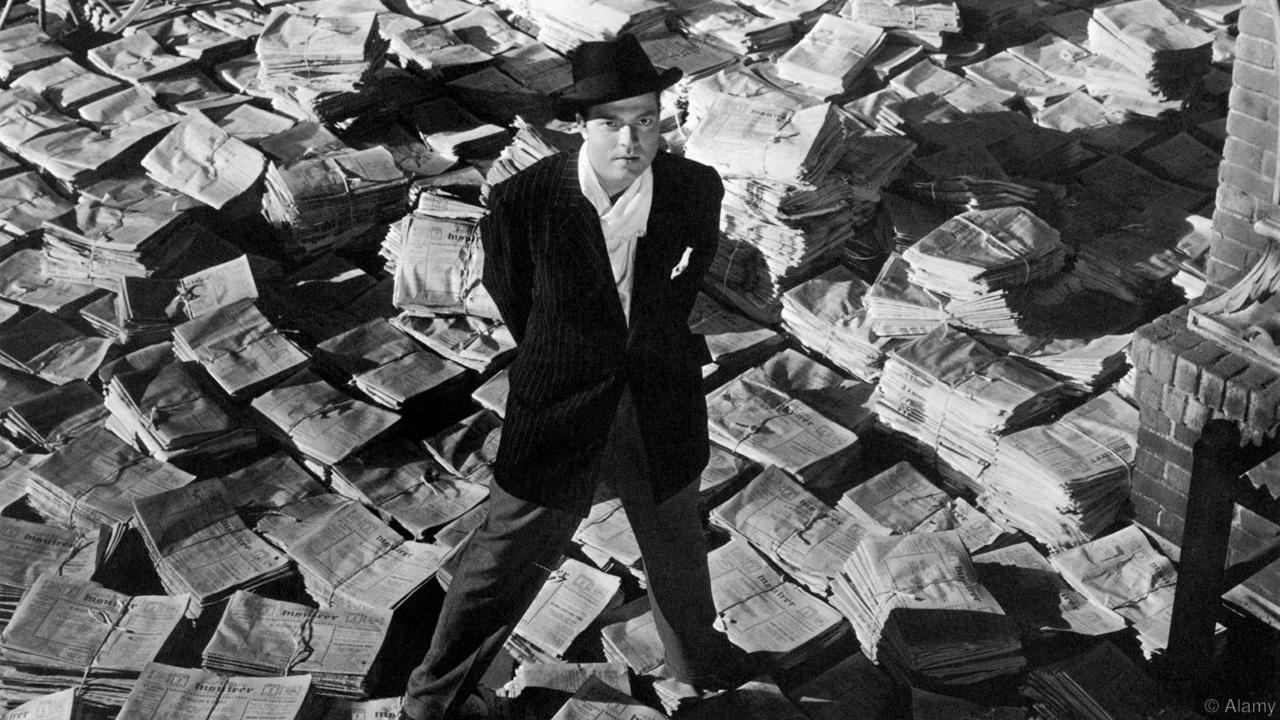
At its heart, Citizen Kane is a fascinating and accomplished mystery movie whose plot is an attempt to sum up a man’s life by examining the people and events that are central to his existence. It’s a remarkable jigsaw puzzle—a clever metaphor that is reflected throughout the film—giving the viewer pieces of the title character’s life but never the complete picture of who he is or was. Wealthy newspaper tycoon Charles Foster Kane (played by Orson Welles, who also directed, produced, and co-wrote the film) dies at the start of the film, and ostensibly, the rest of the narrative is a series of interviews and flashbacks that viewers must use to try assemble into a coherent story. The film has deservedly been hailed as one of the greatest ever made, and every element of it (plot, acting, cinematography, etc.) is first-rate.

Early in the film, a News on the March newsreel gives some highlights of Kane’s public life, but the dissatisfaction with that version of events prompts the quest that makes up much of the rest of the narrative. We never learn any information about Kane directly. All of the details are presented from the perspective of various supporting characters, and none of them are particularly reliable as narrators. Mr. Bernstein (Everett Sloane), Kane’s business manager, is a sycophant who is always loyal to his employer. Kane’s second wife, Susan Alexander Kane (Dorothy Comingore), is a resentful drunk who has twice suffered public embarrassment due to Kane’s actions. His friend Jedidiah Leland (Joseph Cotton) doesn’t speak with Kane for years after the publisher fires him. Walter Parks Thatcher (George Coulouris), the banker who sparred repeatedly with Kane over his expenditures, has already died, but we still learn his opinions from unpublished memoirs in his library, perhaps the most intriguing way that the film calls into question the reliability of people’s descriptions of others. Even Raymond (Paul Stewart), the butler who speaks to the reporters at the film’s end, only knew him later in life and cannot truly shed much light on who Kane is.

Interestingly, Welles as Kane doesn’t appear in the film for almost 25 minutes. Welles, a young man who was making the transition from theater to film, has to progress from a young, dashing man interested in conquering the world to an old, tired man who has lost everything and everyone important to him. Welles is perhaps more successful in portraying the older Kane, but he is ably supported by a uniformly great supporting cast. Agnes Moorehead as Kane’s mother has a relatively small part but is impressive as always, able to convey a wealth of emotion with only the slightest of facial expressions. Ruth Warrick as Kane’s first wife, Emily, gets a great humorous sequence involving a series of meals at the family table. Cotton brings a great charm and sense of humor to his part as Leland; Cotton was, in my opinion, always somewhat underrated as an actor. The greatest revelation, though, is Comingore as Susan. Whether she’s playing sensitive and weak or shrill and strong, she’s mesmerizing. The film requires her to portray both an inept opera singer and a drunken nightclub owner wistful and bitter about her years with Kane, and Comingore excels at depicting every aspect of the character.

The film also features amazing art direction, set decoration, editing, and cinematography. Much has already been written about the technical mastery of Welles and his colleagues, such as the use of deep focus, for example, but the film’s skillful use of these techniques is perhaps best enjoyed by looking at specific instances. Take the opening sequence’s use of a series of dissolves to move viewers from a golf course to a zoo to a light in the window of Kane’s bedroom. Or look at the way that the interviews the reporters in the film conduct with Susan Alexander Kane in her nightclub, the El Rancho, are set up. We watch as the camera pans up to enter through the skylight during a rainstorm. It’s quite dazzling and one of the best representatives of the remarkable camerawork that elevates the film’s overall quality.

The film also uses editing techniques to reveal details about Kane’s life and his interactions with others and then to raise questions about those very details. Susan’s debut as an opera singer is shown twice from different perspectives. During the version that shows what happens from her perspective, Kane is sad. When it is shown from Leland’s perspective, Kane is angry. The use of superimposed images during these sequences also reveals the differing emotional responses of various characters. One of my favorite sequences is the montage of Kane and his first wife having dinner together. As their relationship begins to disintegrate, the table gets longer and longer and the distance between them gets greater and greater. It’s a delightful use of visual images to punctuate the progress of their relationship.

The first half of film, roughly, covers Kane’s rise to prominence as a newspaper magnate and political provocateur. It reveals his lifelong penchant for collecting: newspapers, reporters from competing newspapers, artwork from Europe, and wives. It’s an intriguing depiction of how one’s background can lead to the overaccumulation of objects to fill a void left from the loss of something important in one’s life—in Kane’s case, his mother, who sent him away as a young boy to live with Thatcher and become educated. The second half primarily focuses upon what Kane loses as his hubris grows, and it is quite an extensive list: a gubernatorial race, his first wife, his best friend, the respect and friendship of many of his colleagues, his second wife, and ultimately, any interest in even his own life.  

Kane never seems to get the love that he wants in life. He’s alone by the end of the narrative being recounted by everyone, surrounded only by servants he pays to care for him. Citizen Kane seems to ask what good is the acquisition of wealth and power if you wind up having no one with whom to share? Does the accumulation of treasures and influence fill that emotional void? That’s why the revelation of what the word “Rosebud” (the last word that Kane utters before he dies in the film’s opening sequence) is so touching, and the final image of the film is so resonant. (One question that has never been answered to my satisfaction: How does anyone know what his last word is? He’s alone when he dies if the beginning of the film is to be believed.) Learning what Rosebud refers to does require some remembering on the part of the audience, but it represents the last piece of the puzzle the film is willing to reveal about him.

There is, of course, the controversy over whether Welles and the other filmmakers were trying in Citizen Kane to criticize and/or ridicule newspaper magnate William Randolph Hearst. It isn’t necessary to know all (or even any) of the details about the controversy or Hearst’s life to enjoy the film. Knowing that Hearst was personally offended by the film and tried to have it shelved adds an interesting layer to the mythology that has grown up around the film. There’s a great documentary about the controversy, The Battle over Citizen Kane, Oscar-nominated for Best Documentary Feature of 1996, that provides some context to anyone interested.

Oscar Win: Best Original Screenplay


Other Nominations: Best Picture, Best Actor in a Leading Role (Orson Welles), Best Director, Best Black-and-White Cinematography, Best Black-and-White Art Direction-Set Decoration, Best Sound Recording, Best Film Editing, and Best Scoring of a Dramatic Picture 

Saturday, July 19, 2008

Sergeant York (1941)


Sergeant York, nominated for Best Picture of 1941, probably earned its spot on the list thanks to the lead performance of Gary Cooper. Cooper was always best at roles that required some measure of restraint and quiet, and he found no better part than that of World War I hero Alvin York. The film itself is pretty standard for a biopic, with its attention to the major events of York's life, especially the difficulty that the poor face in trying to make a living or even perhaps get a chance at a better life.

York was a simple farmer from Tennessee who was drafted into military service. Having recently become a Christian after quite a few years of what my grandmother would have called "carousing," he holds fast to the principles that he has learned in church and from talks with his minister, Rosier Pile, played by Walter Brennan. After several attempts to get out of military service as a conscientious objector, York becomes a war hero by almost single-handedly capturing a troop of German soldiers. He uses the trick of gobbling like a turkey to pick off soldiers one by one, a trick he had demonstrated earlier in the movie in attempting to win the prize money at a turkey shoot.

Cooper plays York as an innocent, someone who is naive to the ways of the world. He seems to find almost everything new to be awe-inspiring and even miraculous. He also has incredible luck throughout the years he was in the military. Unlike back home in the hills, where he has been cheated out of some land by someone jealous over York's relationship with a pretty unmarried girl (Joan Leslie, affecting an unbelievably bad accent), in the Army and in Europe and even in New York after his service has ended, York is never taken advantage of and no one ever encourages him to do the wrong thing. I'm not sure that the real Alvin York was so lucky and/or--dare I suggest it--simple-minded as he is played here, but Cooper manages to show us that strength of character is the virtue most likely to keep you alive and successful.

This film is more overtly Christian in its tone than you might expect from a Hollywood film of its time, but it isn't "preachy." In fact, the conflict between York's patriotism and his religious faith is handled with intense seriousness. It's a further testament to Cooper's acting ability that he can show the difficulty that York faced in making the decision of which was to be more important to him: service to his country or the principles he learned in his church. Never during the course of the film did I feel manipulated, and that's probably a trait that has been lost in the art of moviemaking since Sergeant York was first released.